Why Congress Is Concerned About CJP’s Rise Amid the ‘Vote Chori’ Political Campaign
The growing presence of the Cockroach Janta Party (CJP) in protests over alleged electoral irregularities is creating a new political challenge for Co...
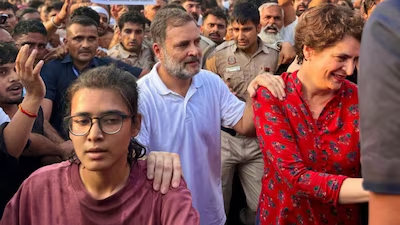
The growing presence of the Cockroach Janta Party (CJP) in protests over alleged electoral irregularities is creating a new political challenge for Congress, even as both groups question the Election Commission’s handling of voter lists. Their shared criticism has not translated into a joint political campaign, raising questions about competition for public attention, leadership and support among voters.
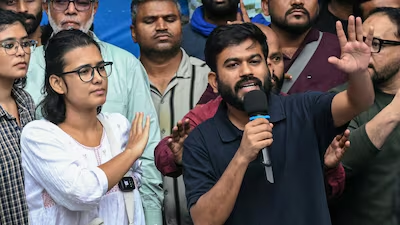
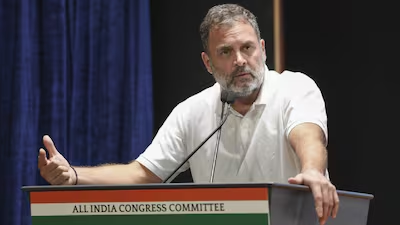
Congress leader Rahul Gandhi has made ‘vote chori’ a central theme of the party’s opposition campaign. CJP has adopted similar messaging through street demonstrations and demands for accountability from Chief Election Commissioner Gyanesh Kumar. Despite these overlapping positions, the two groups have continued to organise their activities separately.
A Shared Issue, Different Political Strategies
The distance between Congress and CJP reflects a broader question about how political parties and emerging movements approach the same public issue. Congress is an established national party with an electoral organisation, state-level leadership and a long-standing parliamentary presence. CJP, by contrast, has built visibility through protest activity and youth mobilisation.
When different groups campaign around the same issue, their messages may reinforce each other, but they can also compete for media attention and public recognition. For Congress, maintaining ownership of its ‘vote chori’ campaign matters because the issue has become a prominent part of Rahul Gandhi’s political argument against the government and the electoral system.
However, the existence of a separate movement raises the possibility that some supporters may begin associating the campaign with more than one political actor. That can create pressure on an established party to demonstrate that its strategy remains relevant and effective.
Earlier Protests Highlight the Divide
The groups’ separate approaches have been visible during demonstrations on electoral issues and other controversies. During the protests surrounding the NEET-UG examination controversy earlier in 2026, CJP organised a march calling for accountability and changes in the education system. Congress also staged its own demonstration, pressing for action over alleged examination irregularities and demanding political accountability.
Although both groups raised concerns about issues affecting students and public institutions, they followed different protest programmes. Their responses illustrated how organisations can share demands without forming a common platform or coordinating their political activity.
A similar pattern has emerged in demonstrations concerning alleged voter-list manipulation. Congress leaders and other opposition figures have pursued their own programmes, while CJP has continued its separate mobilisation against the Election Commission.
Why the Relationship Matters
The political significance of this separation extends beyond the immediate protests. Opposition campaigns often depend on keeping public attention focused on an issue over an extended period. Separate demonstrations can widen the discussion, but differences in leadership and strategy may prevent groups from presenting a unified front.
For Congress, the challenge is to sustain its campaign while responding to the emergence of other voices raising similar concerns. For CJP, continued visibility depends on maintaining public engagement and establishing its own identity rather than being viewed only in relation to larger political parties.
The dispute over electoral processes remains politically sensitive, with allegations about voter-list revisions continuing to generate debate. Such claims require examination through evidence and the appropriate institutional processes.
Whether the two groups eventually coordinate more closely or continue to operate independently will depend on their political priorities and future decisions. For now, their parallel campaigns demonstrate that agreement on an issue does not necessarily lead to a shared political strategy.
Related Stories

Reader comments are moderated as per Daily News Axis editorial standards.