Israel Election Deadlock: Five Possible Scenarios That Could Keep Benjamin Netanyahu in Power
Israel is facing another period of political uncertainty after its 2026 general election failed to produce a clear parliamentary majority. Prime Minis...
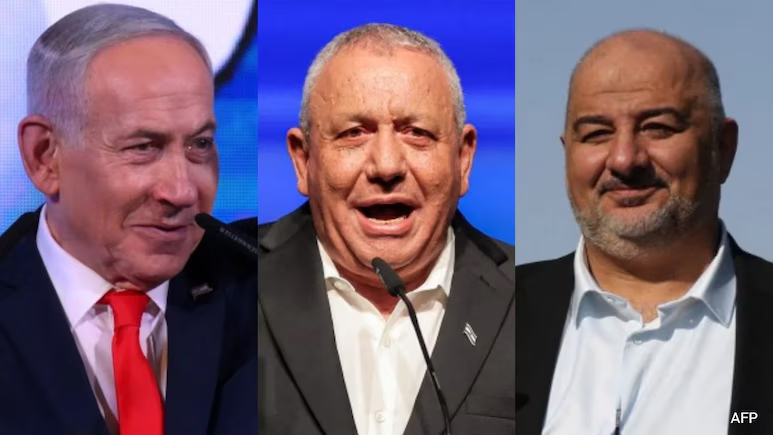
Israel is facing another period of political uncertainty after its 2026 general election failed to produce a clear parliamentary majority. Prime Minister Benjamin Netanyahu's right-wing coalition emerged as the largest bloc, but it remains short of the numbers required to form a government independently. The opposition, led by centrist politician Gadi Eisenkot, also faces difficulties assembling a viable coalition.
The final results show Netanyahu's bloc with 53 seats in the 120-member Knesset, while the opposition grouping secured 48. Arab political parties, Ra'am and the Joint List, won a combined 19 seats, placing them in a potentially decisive position during negotiations.
A government needs the support of at least 61 lawmakers. With neither main camp reaching that threshold, Israel could face weeks of negotiations and potentially another election.
1. A Unity Government Led by Netanyahu
One possibility is a broad coalition bringing together Netanyahu's Likud party and centrist or right-wing opposition groups.
A proposed arrangement involving Gadi Eisenkot's Yashar party, Naftali Bennett's Together faction and Avigdor Lieberman's Israel Our Home could produce 66 seats when combined with Likud.
However, the political obstacles are considerable. Netanyahu would probably have to distance himself from some of his existing far-right and ultra-Orthodox allies. Opposition leaders, meanwhile, would have to abandon their campaign commitments to remove him from office.
Such a government could become an option if prolonged negotiations leave both political camps unable to form an alternative.
2. A Rotational Unity Government
Another possibility involves a power-sharing arrangement in which Netanyahu and an opposition leader serve as prime minister at different stages of the government's term.
This model could offer a compromise by allowing rival political groups to participate without agreeing on a single leader for the entire period.
However, Netanyahu's position as head of the largest party and the larger parliamentary bloc could make him reluctant to accept a rotating arrangement. Opposition leaders would also face criticism from supporters who voted specifically to end his premiership.
Although politically difficult, the possibility remains part of the broader discussion surrounding coalition negotiations.
3. Netanyahu Could Seek Support From Opposition Lawmakers
Netanyahu could attempt to rebuild a parliamentary majority by persuading individual lawmakers or members of opposition parties to join his side.
His coalition currently has 53 seats, leaving it eight short of the required majority. Convincing enough opposition members to switch allegiance could therefore allow him to form a government without negotiating a complete unity arrangement.
Netanyahu has previously demonstrated an ability to attract political support across party divisions. However, opposition leaders have publicly ruled out joining a government under his leadership, making this route uncertain.
4. A Minority Government Led by Gadi Eisenkot
The opposition could also explore forming a minority government with outside support from Arab political parties.
Eisenkot's grouping has 48 seats, while Ra'am and the Joint List together hold 19. Their combined parliamentary strength would reach 67 seats.
Under this arrangement, the Arab parties might support the government in key parliamentary votes without formally joining the Cabinet.
However, the proposal faces significant political resistance. Some potential coalition partners, including Bennett and Lieberman, oppose relying on Arab parties for government formation. Public attitudes towards Israel's Arab minority have also hardened following the October 7, 2023, Hamas attack.
Ra'am previously supported an Israeli coalition government in 2021, demonstrating that such cooperation is possible, although that administration collapsed after approximately 18 months.
5. Israel Could Hold Another Election
If coalition negotiations fail, another general election could become unavoidable.
After the formal results are published, President Isaac Herzog will consult political representatives and nominate the candidate he believes has the best chance of forming a government.
The selected candidate will receive an opportunity to assemble a parliamentary majority. If the initial attempt fails, another leader may be given the chance. The process has an overall timetable of approximately 100 days.
If no candidate succeeds, Israel will return to the polls. Herzog has urged political parties to approach negotiations with an open mind and make every effort to avoid another election.
Arab Parties Hold a Crucial Position
The combined 19 seats secured by Ra'am and the Joint List have made Arab political representation particularly important in the post-election negotiations.
Their support could help the opposition establish a parliamentary majority, but disagreements among potential partners complicate that possibility. Netanyahu has also challenged the legitimacy of relying on Arab parties for government formation.
The election has therefore produced a situation in which smaller political groups could have considerable influence over the country's next administration.
What Happens Next?
Israel's immediate political future will depend on negotiations among party leaders, the presidential consultation process and whether rival groups are willing to compromise on their campaign positions.
Netanyahu remains caretaker prime minister while the process continues. Although his coalition lacks an independent majority, its position as the largest parliamentary grouping gives him a route to remain in office.
The five scenarios illustrate how Israel could emerge from the deadlock, but none is guaranteed. If political divisions prevent an agreement, another election may simply extend the country's period of uncertainty.
Related Stories


Reader comments are moderated as per Daily News Axis editorial standards.