
Scientists Explore the Possibility of Superhabitable Planets That Could Be Better Suited for Life Than Earth
Earth is the only known planet to support life, but scientists are investigating whether worlds elsewhere in the universe could offer even more favour...
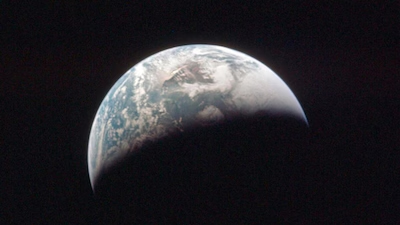
Earth is the only known planet to support life, but scientists are investigating whether worlds elsewhere in the universe could offer even more favourable conditions for living organisms. These hypothetical worlds, known as superhabitable planets, could have environmental characteristics that make them more suitable for life than Earth in certain respects.
The idea does not mean that Earth is unsuitable for life. Instead, it raises a scientific question: could planets with different sizes, temperatures, oceans and atmospheric conditions provide environments where life could emerge more easily or thrive for longer?
Researchers are exploring this possibility as advances in astronomy allow them to identify planets beyond our solar system and study the conditions that might exist on their surfaces.
What Makes a Planet Superhabitable?
A superhabitable planet is a theoretical world whose environmental conditions may be more favourable to life than those found on Earth. Scientists consider several characteristics when assessing this possibility, including surface temperature, water availability, atmospheric stability and the planet's long-term geological activity.
Some research suggests that a planet slightly larger than Earth could have advantages. A greater mass might help it retain internal heat for longer, potentially supporting geological processes that recycle important elements and help regulate the climate.
Such a planet could also maintain a stable environment over an extended period, giving life more time to develop and diversify. However, the relationship between a planet's size and its habitability is complex. A world that is too massive could develop conditions very different from those required for Earth-like life.
Temperature is another important consideration. A planet with a moderately warmer climate than Earth's might support larger areas of liquid water, depending on its atmosphere, surface geography and distance from its star.
Stars Could Determine How Long Life Survives
The star a planet orbits may be just as important as the planet itself. Some stars, particularly smaller and cooler stars, can remain stable for much longer than the Sun. In theory, planets around suitable long-lived stars could have more time for biological evolution to take place.
However, planets orbiting these stars may face other challenges. Some smaller stars produce powerful bursts of radiation that could damage atmospheres or make surface conditions difficult for life. A long stellar lifetime alone does not guarantee that a planet will be habitable.
Scientists must therefore consider the relationship between a planet and its star rather than assessing either one in isolation.
Water, Atmosphere and Geological Activity Matter
Liquid water is considered an important ingredient for life as we understand it. A suitable atmosphere can help maintain temperatures, protect the surface from harmful radiation and support stable environmental conditions.
Geological activity may also play a role by cycling carbon and other essential elements between a planet's interior, surface and atmosphere. These processes can help regulate climate over long periods.
Yet there may be limits to these advantages. Too much water could leave a planet with little exposed land, while an unsuitable atmosphere or unstable climate could undermine its potential to support life.
Scientists also acknowledge that life beyond Earth might not follow precisely the same biological patterns seen on our planet. Consequently, definitions of habitability must remain open to new evidence.
Could Scientists Find a Better World?
Astronomers have discovered thousands of planets outside our solar system, but determining whether any could support life remains difficult. Researchers can estimate certain characteristics, including a planet's size, orbit and distance from its star. Measuring its atmosphere and identifying possible signs of biological activity are much more challenging.
A planet classified as potentially habitable should not automatically be described as inhabited. Confirming life would require convincing evidence that cannot be explained by non-biological processes.
The search for superhabitable planets could help scientists refine the criteria used to select promising targets for future observations.
The key takeaway: Earth remains the only confirmed home of life, but it may not represent the best possible environment for every form of life in the universe. Superhabitable planets remain a scientific possibility, not a confirmed discovery. As astronomical technology improves, researchers may gain a clearer understanding of whether other worlds offer conditions more favourable to life than those found on our own planet.
Related Stories


Reader comments are moderated as per Daily News Axis editorial standards.








