Dr. Nikunj Vaghasiya’s research uses artificial intelligence to prioritise 100 potential bacteriophage candidates against Klebsiella pneumoniae
Ahmedabad, Gujarat |6 October 2026 : A new computational research study by Gujarat’s young researcher Dr. Nikunj Vaghasiya is exploring how artificial...
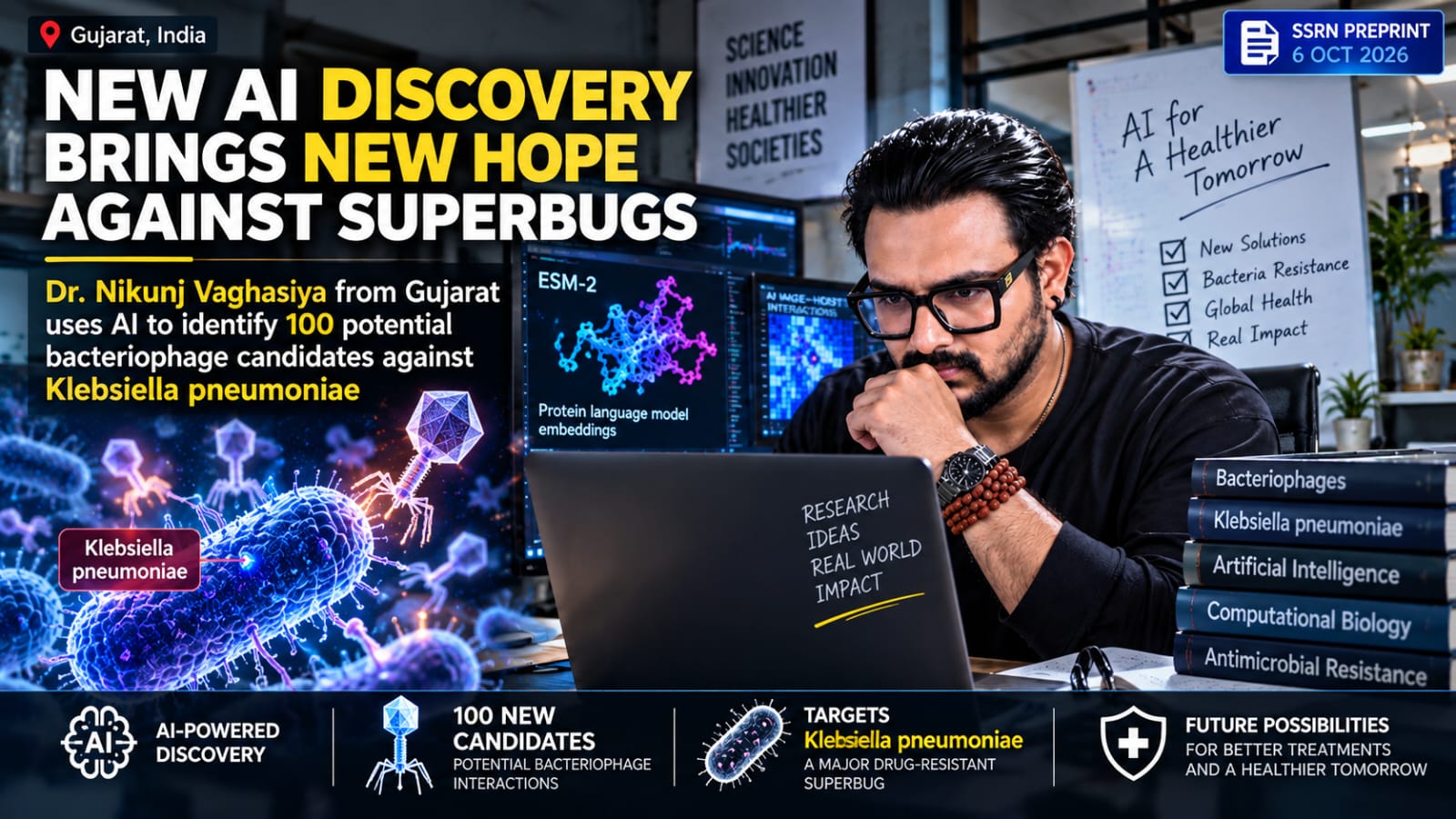
Ahmedabad, Gujarat |6 October 2026: A new computational research study by Gujarat’s young researcher Dr. Nikunj Vaghasiya is exploring how artificial intelligence could help scientists identify potential new ways to fight Klebsiella pneumoniae, a bacterium associated with antimicrobial resistance.
The research uses artificial intelligence, ESM-2 protein-language-model embeddings and machine-learning techniques to analyse bacteriophage bacteria interactions and identify candidates for further scientific investigation.
The 16-page study, titled “Leakage-Controlled Evaluation and Candidate Prioritization of Klebsiella pneumoniae–Bacteriophage Interactions from ESM-2 Embeddings: A Re-analysis of the PhageHostLearn Dataset,” is available as a preprint on SSRN, with Abstract ID 7562818.
WHAT COULD THIS MEAN FOR PEOPLE?
Klebsiella pneumoniae can be difficult to tackle because interactions between bacteria and bacteriophages can be highly specific.
The study investigates whether AI can help researchers narrow down thousands of possible bacteria phage combinations and identify candidates that may deserve further laboratory investigation.
AI IDENTIFIES 100 POTENTIAL CANDIDATES
After computational analysis, the study scored 10,994 feature-supported unobserved pairs and generated a shortlist of 100 computational candidates.
These candidates represented 73 different host genomes and 62 phages, with every selected pair re-checked against the source interaction matrix as unobserved.
The aim is not to claim that these candidates are already treatments. Instead, they provide potential research targets for future experimental testing.
TESTING WHETHER AI CAN WORK ON UNSEEN BACTERIA AND PHAGES
The researchers evaluated the models under three increasingly difficult conditions:
• Unseen host genomes
• Unseen phages
• Both host and phage unseen
On the fixed evaluation split, the XGBoost model achieved AUROC/AUPRC values of 0.810/0.479 for unseen genomes, 0.775/0.338 for unseen phages and 0.711/0.298 for the double-holdout setting.
The study also repeated the evaluation across ten resampled splits. Performance was weaker when both biological partners were unseen, demonstrating the difficulty of transferring AI predictions to completely new host phage combinations.
A POSSIBLE FUTURE DIRECTION
The research explores AI as a screening and prioritisation tool in biological research.
Instead of experimentally testing every possible bacteria phage combination, computational methods could potentially help researchers decide which combinations are worth investigating first.
However, the study has not yet experimentally tested the 100 candidates. It is a computational study with no wet-lab experiments, and the paper describes the candidates as computational hypotheses rather than confirmed biological interactions or treatments.
ABOUT DR. NIKUNJ VAGHASIYA
The paper lists Nikunj Vaghasiya as the author and identifies his affiliation as Indian Institute of Technology Mandi, Himachal Pradesh, India, with his professional role listed as Director, Softcodex AI.
His research combines artificial intelligence, machine learning and computational biology to investigate how modern AI methods can be applied to challenging biological problems.
RESEARCH AVAILABLE PUBLICLY ON SSRN
Title: Leakage-Controlled Evaluation and Candidate Prioritization of Klebsiella pneumoniae–Bacteriophage Interactions from ESM-2 Embeddings: A Re-analysis of the PhageHostLearn Dataset
https://papers.ssrn.com/sol3/papers.cfm?abstract_id=7562818
Related Stories


Reader comments are moderated as per Daily News Axis editorial standards.